

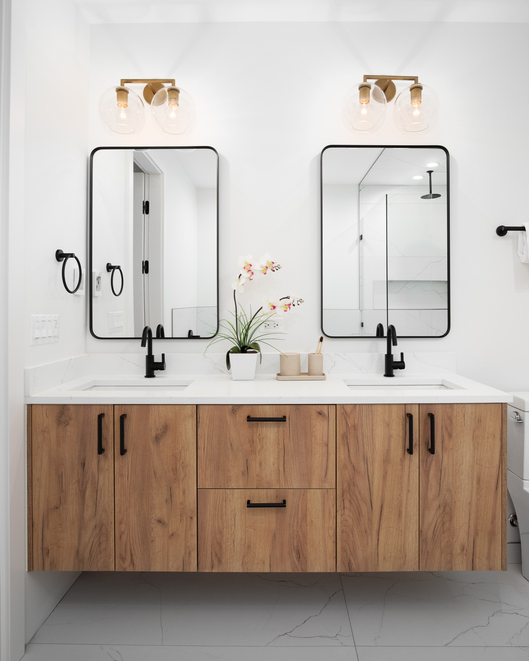
Installing a large mirror in a bathroom, hallway, or entryway is often more complex than it appears. While the glass itself is straightforward, the surrounding environment dictates the final shape. In many Ontario homes, electrical fixtures, light switches, and decorative sconces are installed before the mirror is ordered. This sequence creates a common challenge: ensuring the mirror fits perfectly without covering or interfering with these essential elements.
The solution is precise custom mirror cutouts for outlets and sconces. Rather than using a standard rectangular panel that may require awkward trimming or leave unsightly gaps, a custom-fabricated mirror can be shaped to accommodate specific hardware. This approach preserves the aesthetic integrity of the space while ensuring functional access to electrical components.
Why Final Fixture Locations Matter
Many homeowners assume that electrical boxes are placed in standard positions. In reality, every home is different. Older properties in the GTA often have non-standard switch heights or outlet placements that deviate from modern norms. Even in new builds, the final position of a sconce may shift during rough-in to align with tile patterns or cabinetry.
If a mirror is ordered based on rough estimates, it may cover a switch, obscure a light fixture, or leave a visible gap that compromises the design. By waiting until the final fixture locations are confirmed, you ensure that the mirror’s cutouts align exactly with the hardware. This eliminates the need for on-site adjustments, which can be difficult to execute cleanly on installed glass.
Measurement and Edge Clearances
Accurate measurement is the foundation of a successful installation. When determining the size of the cutouts, several factors must be considered:
- Fixture Dimensions: Measure the exact width and height of the outlet, switch, or sconce base. Include any protruding elements, such as pull chains or decorative arms.
- Edge Clearance: It is crucial to leave a small margin around the fixture. A clearance of 10 to 15 millimetres is often sufficient to allow for easy access and to prevent the glass from touching the fixture, which could cause stress or chipping over time.
- Shape Complexity: Simple rectangular cutouts for standard outlets are straightforward. However, circular cutouts for sconces or irregular shapes for unique hardware require more precise templating. Providing a physical template or detailed digital drawings helps ensure accuracy.
Working with a fabricator who understands these nuances ensures that the cutouts are clean and structurally sound. The edge of the cutout should be finished appropriately, such as with a polished or beveled edge, to prevent chipping and enhance the visual appeal.
Electrical Coordination and Safety
While glass is an insulator, the proximity of electrical components requires careful consideration. The mirror should not obstruct access to the electrical box or make it difficult to replace bulbs or flip switches. Additionally, the cutout should be positioned so that the glass does not exert pressure on the fixture. This is particularly important for sconces that may vibrate slightly or for outlets that are frequently used.
It is also important to consider the depth of the electrical box. If the box is recessed deeply, the cutout may need to be larger to accommodate the fixture’s mounting hardware. Conversely, if the box is shallow, a smaller cutout may suffice. A professional can assess these details to ensure a safe and functional installation.
Frequently Asked Questions
Can you cut a mirror after it has been installed?
It is generally not recommended to cut a mirror after installation. The process is risky and can result in chipping or breakage. It is best to order the mirror with the necessary cutouts included from the start.
How much clearance is needed around a sconce?
A clearance of 10 to 15 millimetres is typically sufficient. However, this may vary depending on the specific fixture and its movement. Consult with a professional to determine the appropriate clearance for your project.
What if my fixtures are not in a straight line?
Custom fabrication allows for cutouts in any configuration. Whether the fixtures are aligned, staggered, or irregularly spaced, the mirror can be shaped to accommodate them precisely.
Discuss Your Project
Creating a mirror that integrates seamlessly with your electrical fixtures requires careful planning and precision. By collaborating with a fabricator who understands the nuances of custom cutouts, you can achieve a result that is both functional and aesthetically pleasing. For more information on how to create a mirror that fits your space perfectly, explore our Mirrors collection or request a custom estimate to discuss your specific requirements.